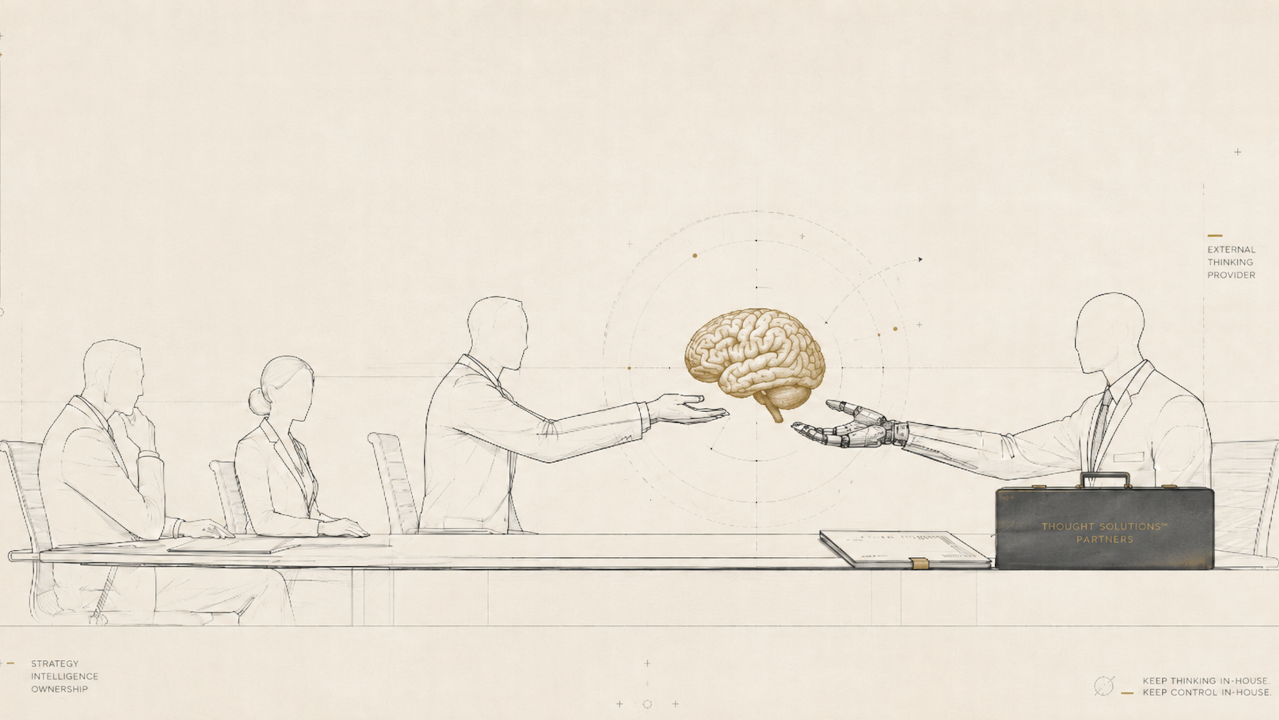
Thinking Is the One Thing You Cannot Outsource
There is a moment in many organisations when a hard problem appears and a decision gets made almost without anyone noticing.
The problem is complex. The internal expertise is thin. And somewhere in the discomfort between those two facts, a conclusion forms:
We need help.
A partner is selected. A programme is scoped. A steering committee is formed. Everyone relaxes slightly.
The problem now has an owner.
It is just not us.
I have watched this pattern for years, across industries, and the responsibility is shared.
Some vendors absolutely benefit from complexity. Long programmes, expanding scope, vague outcomes, dependency, change requests, endless phases. That can be a very good commercial model (for the vendors… ).
But companies make themselves vulnerable when they hand over problems they have not understood deeply enough themselves.
The issue is not only that vendors sell too much. It is that too many organisations do not know how to push back, due to lack of internal knowledge.
Organisations think they are outsourcing work. What they are often outsourcing is thinking.
And thinking is the one thing that cannot leave the building without consequences.
You cannot outsource a problem you do not understand.
A third party solves the problem as briefed. If the understanding behind the brief is shallow, the solution will be expensive shallowness.
The partner is not only delivering to you.
The partner is also amplifying you.
Whatever depth you bring to the table becomes the ceiling of what comes back.
There is a second cost, quieter and larger.
Every engagement makes the vendor smarter about your business. Their pattern library grows. Their next proposal gets sharper.
Meanwhile, your own muscle for the problem stays exactly where it was. Or worse, it atrophies.
You are renting judgement.
And the rent is teaching the landlord.
Then there is accountability, which behaves strangely when thinking is outsourced.
Programme follows programme. Vendor follows vendor. Leaders rotate mid flight. Ownership quietly disappears.
By the time results are due, the people who designed the thing are gone, and nobody truly owns the outcome.
Constant motion. No compounding.
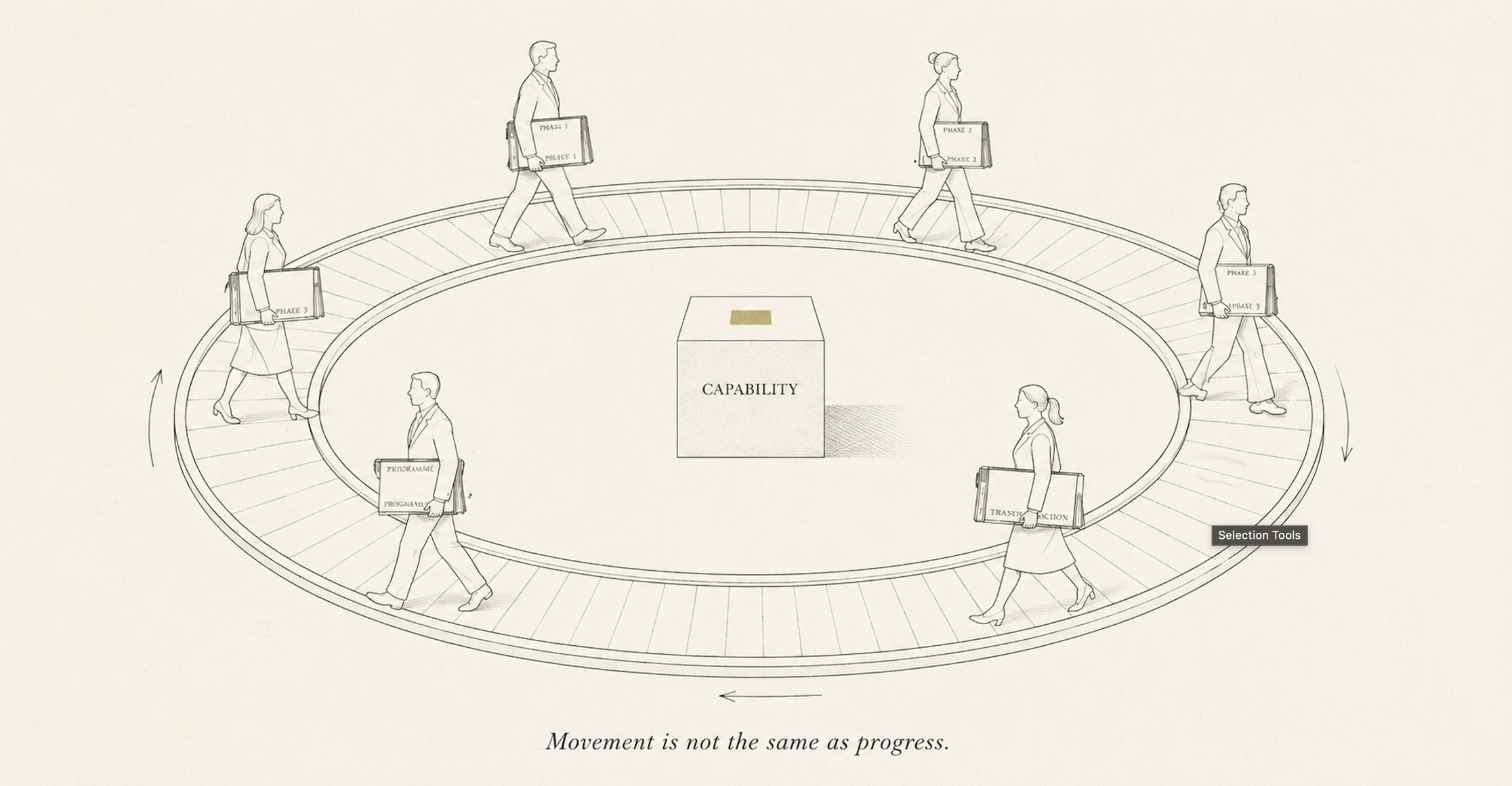
Most large organisations live here and do not realise it.
Why does this keep happening?
The uncharitable answer is laziness.
The more accurate answer is that deep expertise is slow, unglamorous and invisible, while a signed contract is fast, visible and announceable.
Building internal understanding takes years and produces no press release.
Hiring a partner takes a quarter and produces a slide.
Organisations rarely choose shallowness deliberately.
They choose speed, optics and reassurance.
Shallowness is the by product.
None of this is an argument against external help.
Partners bring capacity, pattern recognition and challenge. Used well, they are leverage.
But the best engagements I have seen all had one thing in common:the company brought real understanding to the table.
The external work sharpened the internal thinking.
It did not replace it.
That is the test:
If the partner disappeared tomorrow, would the thinking still be in the building?
The organisations that compound do something different.
They stay close to their hardest problems.
They build expertise precisely where it hurts, because it hurts.
They treat understanding as an asset, even though no accountant will ever put it on the balance sheet.
It is slower at first.
It is faster forever after.
Excellence is built, not transformed.
Partners can help.
But they cannot do the thinking for you.