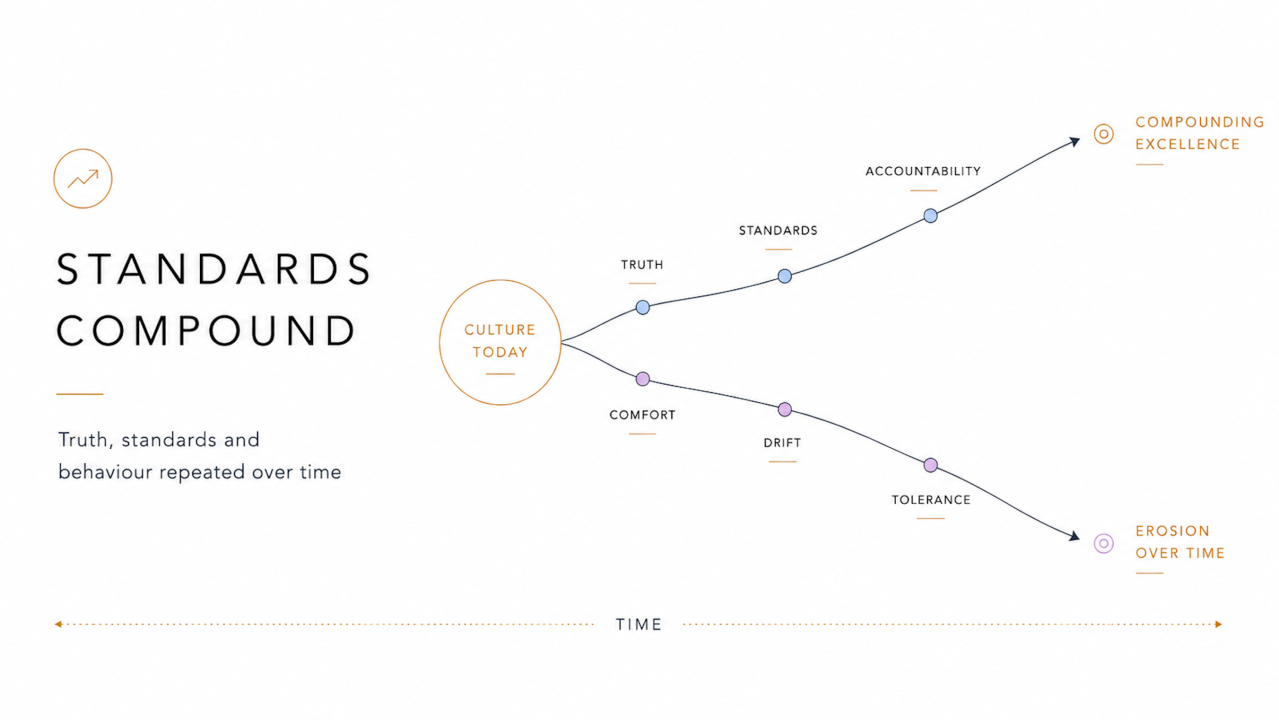
How Standards Compound, Even on the Way Out
The last post on evolution versus transformation triggered more conversations than expected. A lot of them were not about strategy. They were about standards.
Having lived across Armenia, Germany, the UK, Spain and now Switzerland, and having managed teams across the US, Europe and Asia, you start to notice patterns in how teams operate.
They shape how fast teams move, how high they aim, and ultimately what they build.
You often feel it the moment you walk into an office.
In some environments, the energy is unmistakable. Conversations are about the work. The product. The customer. How to improve. How to win.
In others, the centre of gravity shifts. More of the conversation moves towards the system around the work: frameworks, policies, constraints, processes, and negotiations about how the work should happen.
Both can look busy. Only one consistently compounds.
High-performance culture is not a slogan. It behaves much more like elite sport. Michael Jordan, Serena Williams, Cristiano Ronaldo. They did not just raise their own level. They raised the standard for everyone around them. Relentlessly.
That kind of environment can be uncomfortable. It demands more. But it also brings out the best in people.
The opposite dynamic is just as real.
When the focus shifts from contribution to entitlement, from accountability to negotiation, standards do not hold. They drift. And once that drift sets in, even strong performers start adjusting down rather than pulling others up.
A simple chart by William Meijer, recently reshared by Brian Halligan, captures this well. Functional systems are built on unkind truths. Dysfunctional ones are built on kind lies.
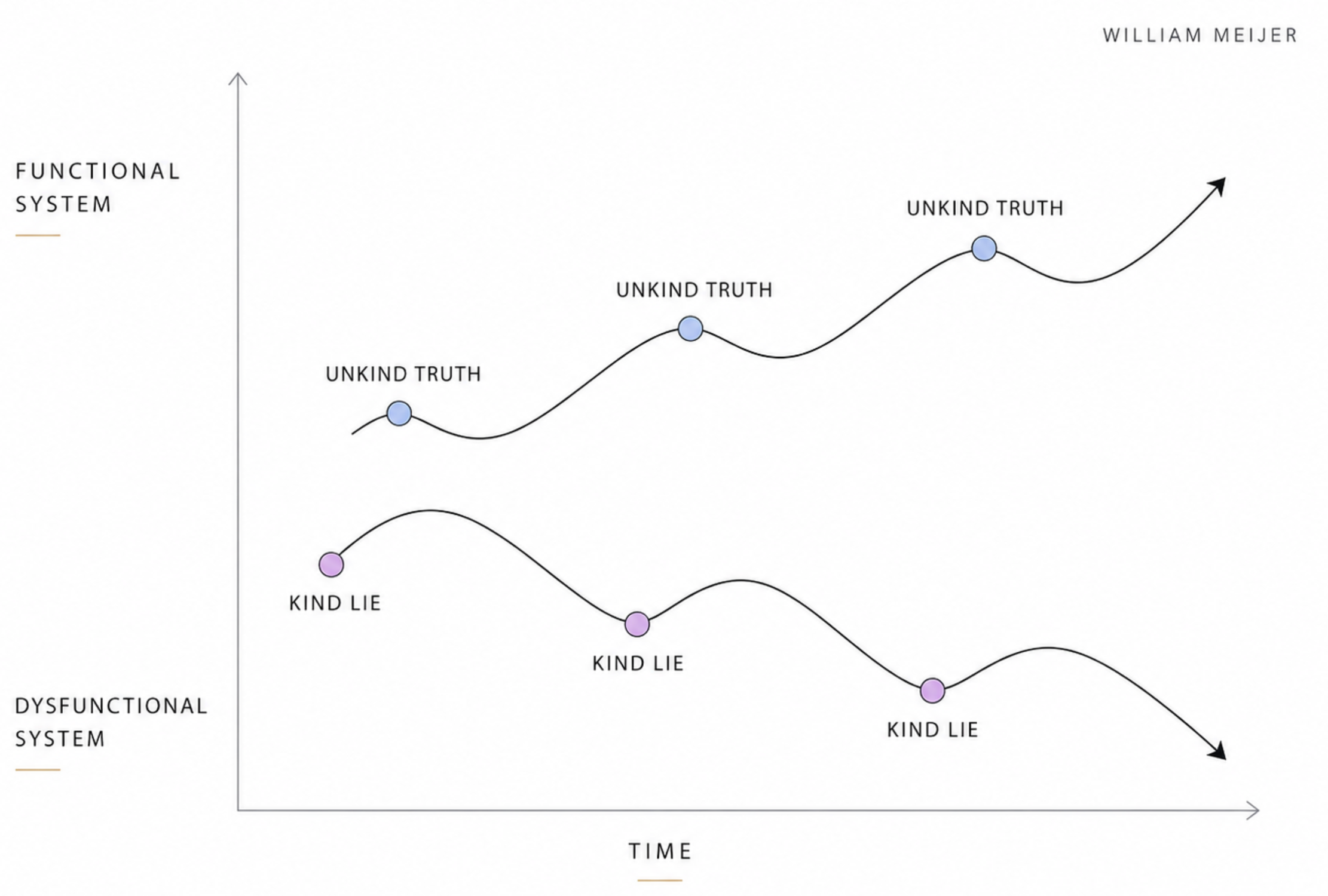
Halligan’s addition is important: how you deliver the truth matters enormously. You can be kind about an unkind truth. What you cannot do, if you care about the system, is replace it with a comfortable lie.
Over time, the gap compounds.
Into trust or avoidance. Into speed or friction. Into excellence or mediocrity.
And the standard you set in how people work eventually shows up in how people leave.
That part is often underestimated. Culture does not reset when someone exits. Reputation travels. In a connected industry, signals compound quickly.
The people who build, contribute, take accountability, and leave well tend to open more doors over time. Years later, they are still benefiting from how they handled the difficult moments.
The opposite is also true. When trust is burned on the way out, it rarely stays contained to one relationship. It shapes how a wider network thinks about working together again.
This is not about geography. It is about what each of us reinforces every day.
Every meeting. Every conversation. Every standard we uphold. Every truth we choose to tell properly rather than soften into something meaningless. Every exit, on either side of the table.
Culture is not set by policy. It is set by behaviour.
Repeated.
Tolerated.
Rewarded.
And it compounds, in both directions.
“If you give in once, you’ll give in twice. It’s a habit.”— Sir Alex Ferguson