
Five Principles for the Modern Tech Leader
Five principles I increasingly believe define the modern technology leader.
Not the CIO as vendor manager. Not the CTO as delivery owner. Not technology as a service function waiting for requirements.
The modern CTO role cannot only be to run technology. It needs to understand how the company actually works.
Not how it is described in decks, but how it is encoded in systems, data, workflows, permissions, tickets and exceptions.
Every product decision eventually becomes data quality. Every supply chain decision eventually becomes system behaviour. Every customer promise eventually becomes an inventory check, a recommendation, a fulfilment promise or a failed integration.
This gives technology leaders a choice. Use the role to manage demand, vendors and roadmaps. Or use it to see the whole company more clearly and help shape what it becomes
These are five principles I lean on.

1. Own the thinking.
Partners matter. Platforms matter. Vendors matter. They are leverage when used well.
But the judgement has to live inside the company.
What should be built? What should be bought? What should be automated? What should stay human? Which data matters? Which capabilities are too strategic to rent?
These are not procurement questions. They are leadership questions. The kind that compound when a company answers them itself.
The best companies in the world treat these questions as their actual work. They go deep on what matters. They build the parts that define them. They rent the parts that do not.
That is how durable advantage gets created. Not by buying it. By thinking your way to it.
2. Treat the foundations as organisational truth.
The foundations, the systems of record, the trusted data underneath everything reveal what is really happening.
They show when two teams are solving the same problem in parallel. They show when strategy has not reached the platforms it depends on. They show when the customer promise is moving faster than the operational reality. They show when the data quietly disagrees with the slide.
A great technology leader does not only fix the foundations. They name what the foundations are revealing.
The fix is often the easy part. Naming the truth that the data has been quietly telling for months is the leadership work. It often requires courage.
3. Build technology judgement across the company.
The goal is not for every business leader to become an engineer.
But in the age of AI, every serious business leader needs more technology literacy. They need to understand what software can do, what agents can change, what data is required, where risk sits, and why architecture matters.
AI makes prototyping easier. That means the company can explore ideas faster. It also means weak judgement can scale faster.
Technology judgement cannot sit in one executive. It has to become an organisational muscle.
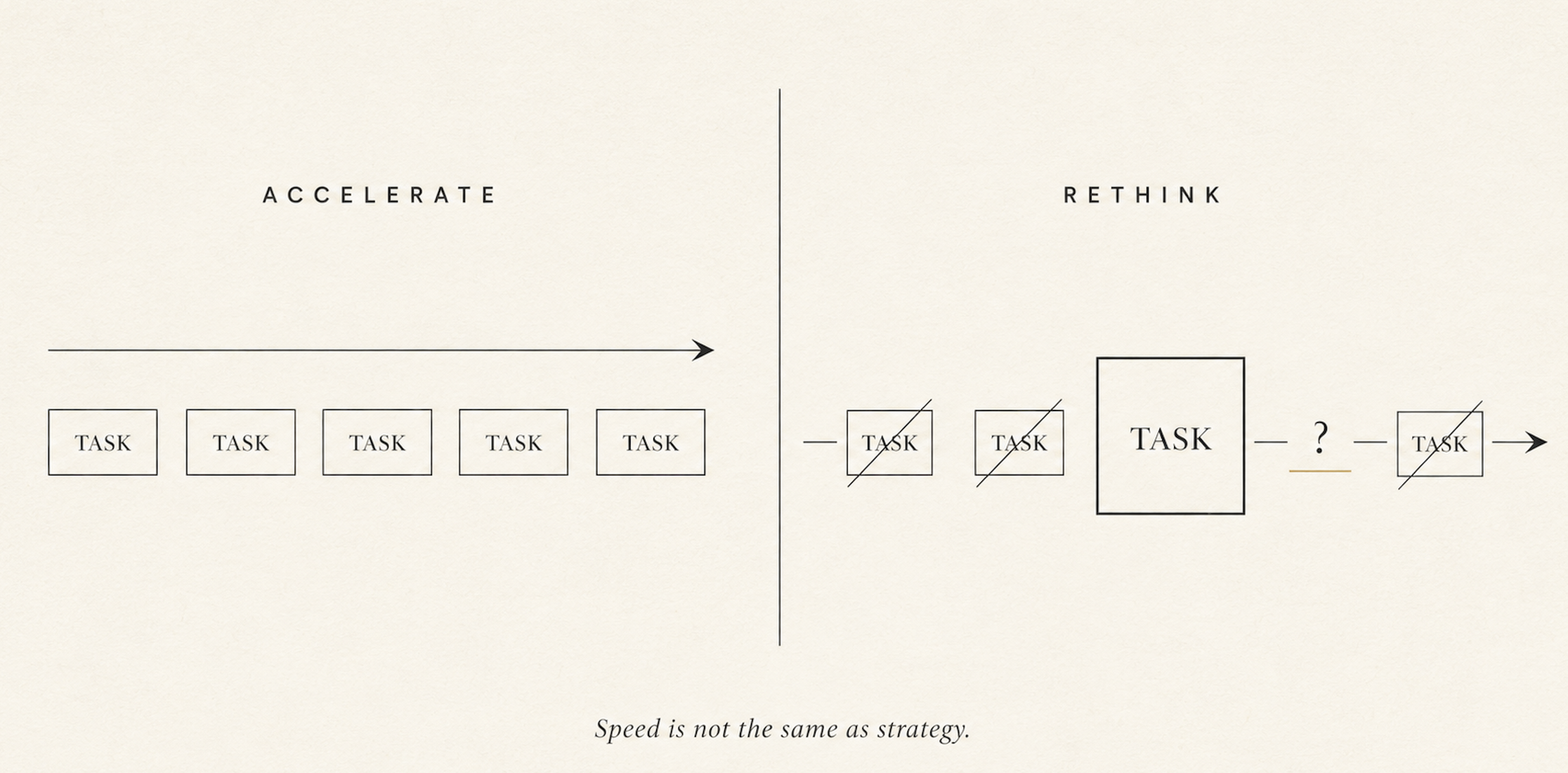
4. Use AI to rethink the work, not just accelerate it.
There is a real risk that companies use agents to speed up legacy workflows without asking whether those workflows should exist at all.
Faster approvals. Faster reports. Faster tickets. Faster meetings.
Useful, but not enough.
The better question is not “how can an agent do this task?”
It is “should this task exist in our operating model?”
That is where AI becomes strategic.
5. Look across silos, then act.
The advantage of the CTO role is not ownership. It is visibility.
Technology touches every part of how the business runs and how it shows up to its customers; be that finance, commercial, supply chain, R&D and so on and so forth. So it is uniquely placed to have a 360 view.
That horizontal view is only valuable if you use it:
That is the choice.
A technology leader can become the person who runs the platforms. Or the person who helps the company understand itself through technology.
One path manages the machinery. The other creates value.
The companies that get this right will not just hire technology leaders to run systems. They will expect them to help shape the business.