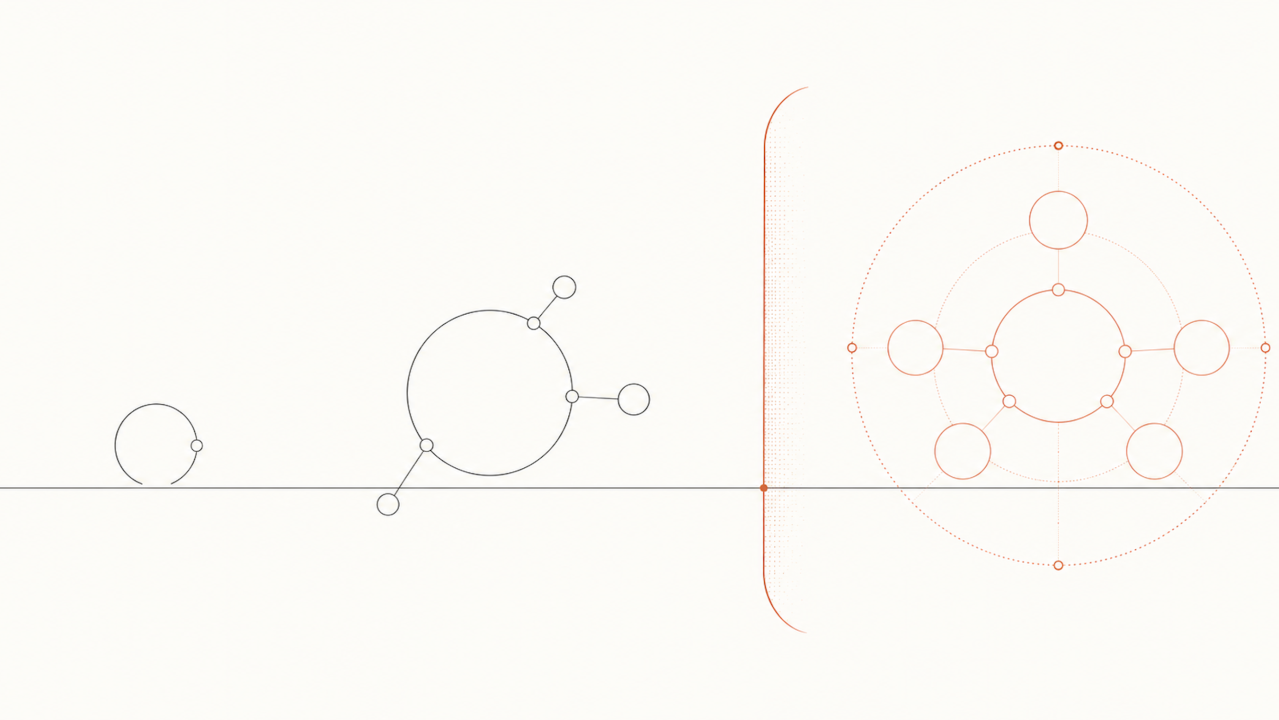
Not all AI agents are the same. Confusing them is quietly stalling enterprise AI.
I have found myself having the same conversation in different situations recently. Someone says: “We need a strategy for AI agents.”
Then, within five minutes, three completely different things are being discussed as if they were one thing.
These are not the same thing. Treating them as one category is one of the reasons enterprise AI stalls.
The three tiers
Tier 1: Personal productivity agents
These help a person do their own work.
They summarise meetings. Draft emails. Analyse documents. Help think through a problem. Prepare a presentation. Write code. Search across knowledge.
They act for an individual.
The human remains accountable. The human decides what to send, publish, approve or execute.
The governance model should be light enough to encourage fluency, experimentation and adoption. Clear usage principles. Data guidance. Training. Sensible controls.
But not a heavyweight production process.
If every personal productivity use case is treated like a production system, people will either stop using the tools or route around the process.
That is how shadow AI grows.
Tier 2: Builder agents
This is the emerging middle layer.
Vibe coding, workflow creation, data app generation, internal tool building.
These tools do not just help someone do work. They help someone create new digital capability.
That is powerful. It also changes the risk profile.
A person can now build an app, an automation, a dashboard or a workflow much faster than before. The bottleneck moves from building to deciding what is safe, reusable and worth scaling.
The governance here should not look like Tier 1, because the output may become something others depend on.
But it should not look like Tier 3 either, because much of this work is still exploratory.
The right model is a golden path.
Make it easy to build in approved environments. Make it easy to use trusted components. Make it easy to publish safely. Make it clear when something is a prototype, when it is a team tool, and when it has crossed the line into production.
This tier is where many companies will either unlock enormous creativity or create a mess of unowned tools.
Tier 3: Enterprise process agents
This is the real shift.
An enterprise process agent does not just help a person.
It acts for the company.
It may monitor demand, inventory, pricing, customer signals, supply constraints, claims, campaigns, orders or financial movements.
It may trigger workflows, update systems, raise tickets, recommend actions, ask for approvals or execute within predefined limits.
It owns an outcome inside a value stream. That makes it part of the operating model, not just part of the tool stack.
The governance here must be full strength.
Identity. Scoped access. Audit logs. Evaluation gates. Monitoring. Escalation paths. Human approval where needed. Cost limits. Loop limits. Kill switch. Clear ownership. Versioning. Testing. Accountability.
Not because we want to slow AI down. Because we want the safe path to be the fastest path.
The line that matters
The most useful question is not:
“Is this an agent?”
The better question is: Does it help a person, help a person build, or act for the company?
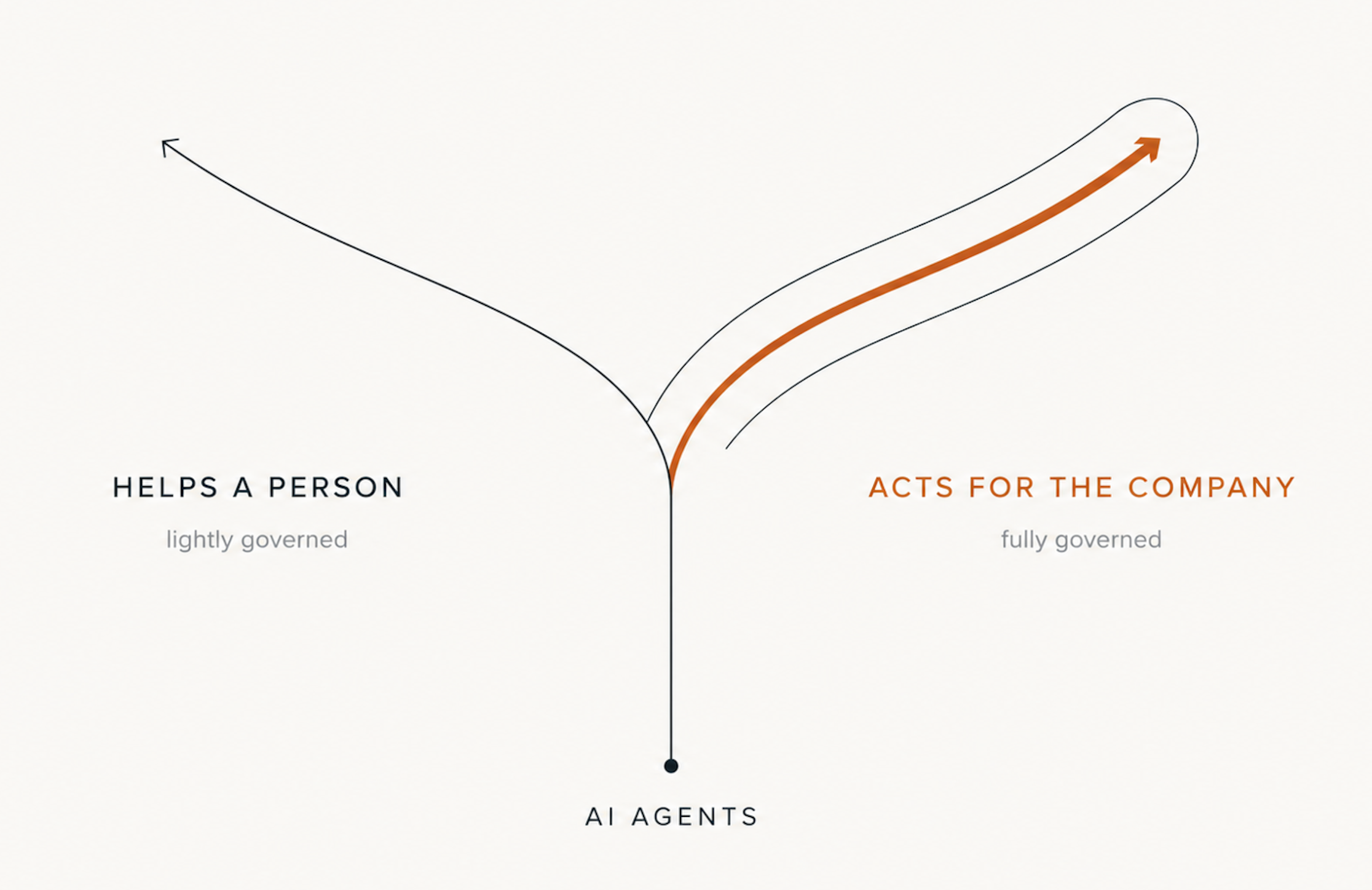
Governance should follow from that answer.
Connectors make the confusion worse. A personal assistant that can reach into enterprise systems can look very similar to a company agent from the outside.
But the accountability is completely different.
That is the line.
The two failure modes
Most organisations get this wrong in one of two ways.
The first failure mode is over governing the light stuff.
Every productivity use case becomes a steering committee. Every experiment needs a business case. Every assistant is treated like a regulated production system.
The result is predictable.
A workflow gets a few connectors. A prototype starts touching real systems. An agent begins to make recommendations that teams act on. Nobody is quite sure who owns it, who approved it, what it can access, how it is evaluated, or how to stop it.
The result is also predictable.
Risk, mistrust and eventual slowdown.
Both failure modes come from the same mistake: collapsing three tiers into one.
Why this matters more, not less
As AI gets more capable, the boundary becomes more important.
The companies that win with enterprise AI will not be the ones with the most pilots, the most assistants, or the most impressive demos. They will be the ones that build a clear operating model for moving from personal productivity, to AI assisted building, to company level execution.
The challenge is not that AI agents are becoming more capable. They are.
The challenge is making sure our organisational wisdom grows at the same speed as the technology.
As Isaac Asimov put it:
“The saddest aspect of life right now is that science gathers knowledge faster than society gathers wisdom.”
That may be the real enterprise AI challenge: not just building more capable agents, but building the judgement, accountability and operating model to use them well.